


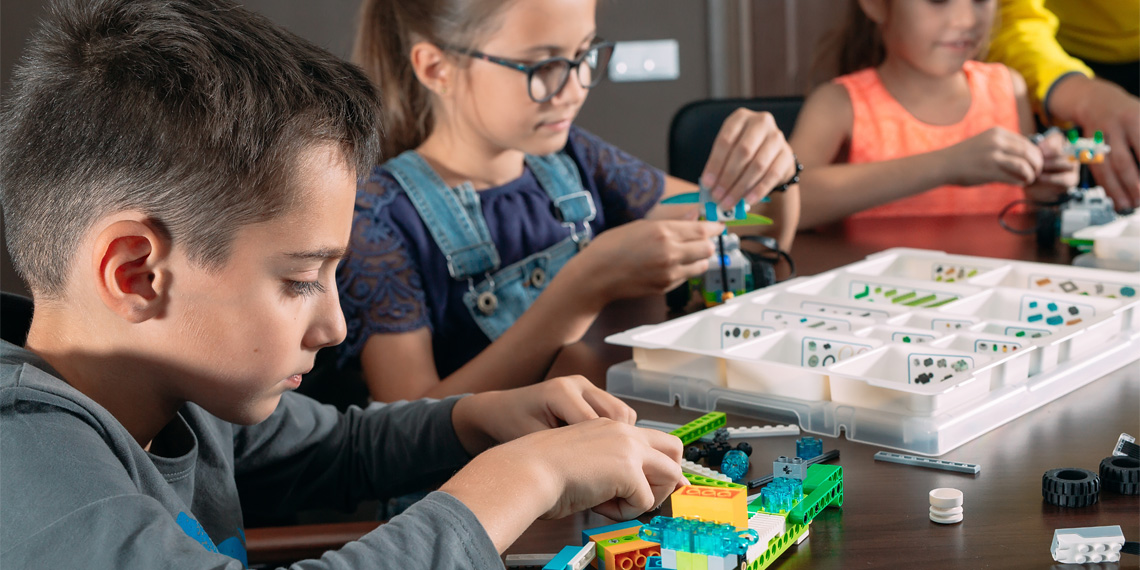
Spatial skills, which involve understanding and manipulating objects in space, play an important role in the relationship between LEGO construction ability and children’s mathematics performance, according to new research published in the journal Child Development.
“Due to the low levels of mathematics achievement in the United Kingdom and beyond, there is a vital need for interventions targeting and improving mathematical abilities,” explained study author Emily McDougal (@mimsiemcd), a postdoctoral researcher on the Block Construction Skills for Mathematics (BLOCS) project at the University of Surrey
“Identifying activities that are effective, efficient and engaging can be challenging. LEGO is a toy already well loved by many children and could be a strong candidate. We wanted to take the first step in exploring its potential by understanding if and how LEGO construction ability and mathematical skills are related. We were also interested in understanding this for both physical and digital LEGO, given the increasing use of technology in the education setting.”
The study involved children from Years 3 and 4 (ages 7 to 9) in eight primary schools in southern England. A total of 358 children participated, with an average age of 8.67 years, including 189 females. The data collection occurred in two time periods: January to March 2020 and May to July 2021, with a break due to the COVID-19 pandemic.
The participants were randomly assigned to either the concrete LEGO or digital LEGO condition. They completed a series of tasks and questionnaires, with the only difference being whether they used physical LEGO bricks or a digital LEGO construction game.
To assess LEGO construction ability, the participants were presented with an exploded diagram of a LEGO model alongside an image of the completed model and were asked to replicate it using LEGO bricks. There were practice trials with feedback, followed by experimental trials without feedback. Accuracy in replicating the models across the trials determined the LEGO construction ability score.
For the concrete LEGO construction, participants received physical LEGO bricks, and photographs of their models were taken from multiple perspectives for later coding. In the digital LEGO construction condition, participants used an online LEGO construction game, choosing bricks from an onscreen panel and constructing the models with a mouse. Their digital models were saved and later coded.
The children also completed assessments of visuospatial working memory (the ability to hold and manipulate spatial information in one’s mind), mental rotation (the ability to mentally visualize and manipulate objects in three-dimensional space), disembedding (the ability to identify or extract a specific shape or object from a complex or cluttered background), spatial scaling (the ability to discriminate and perceive the relative sizes or positions of objects), and spatial numerical associations (the ability to mentally represent numbers along a spatial continuum or number line).
Mathematics measures included the Wechsler Individual Achievement Test III Maths Problem-Solving subtest, assessing problem-solving skills with contextually-based math problems. The WIAT III Numeracy subtest evaluated abstract written arithmetic calculations. Finally, a geometry question set based on White Rose Maths items was used to assess geometry knowledge.
The researchers found that the combination of LEGO construction ability and spatial skills accounted for 8.4% to 26.6% of the variance in mathematics scores. This means that the joint influence of LEGO construction ability and spatial skills accounted for a significant portion of the differences observed in mathematics performance among the participants.
In other words, those with higher LEGO construction ability also tended to have higher spatial skills, which in turn was associated with greater mathematics performance.
The specific spatial skills involved varied depending on whether the task was physical or digital. Mental rotation was a significant factor in the physical condition but not in the digital condition. Other spatial skills, such as spatial numerical associations, disembedding, and visuospatial working memory, played a role in both conditions.
“Our findings show that when children engage in block construction activities, either using physical LEGO bricks or in a digital platform, they are likely to be drawing upon spatial skills that are also important for mathematics,” McDougal told PsyPost. “We also found that children may draw upon different spatial skills depending on the type of LEGO (physical or digital) and the mathematical domain. This is important because it indicates that LEGO construction may be a suitable candidate for interventions aiming to improve spatial skills and mathematics achievement.”
The findings highlight the importance of spatial skills in mathematics performance and suggest that the type of LEGO task may influence the specific pathways through which these skills contribute to mathematical abilities. But while the results provide evidence of associations, they do not prove a cause-and-effect relationship between LEGO construction ability, spatial skills, and mathematics performance.
“Our study didn’t investigate causal associations, therefore we don’t yet know whether training LEGO construction can improve spatial abilities or mathematics performance,” McDougal said. “Ongoing work from our team is investigating this in school settings, which will evaluate the effectiveness and feasibility of LEGO construction interventions.”
The study, “Associations and indirect effects between LEGO® construction and mathematics performance,” was authored by Emily McDougal, Priya Silverstein, Oscar Treleaven, Lewis Jerrom, Katie A. Gilligan-Lee, Camilla Gilmore, and Emily K. Farran.










Discussion about this post