


A study of oceanic dolphins found stranded (and dead) on shores of Scotland showed evidence of pathological changes in their brains that correspond to Alzheimer’s disease in humans. Analyses revealed that all examined cetaceans accumulated amyloid plaque pathology in their brains. The study was published in the European Journal of Neuroscience.
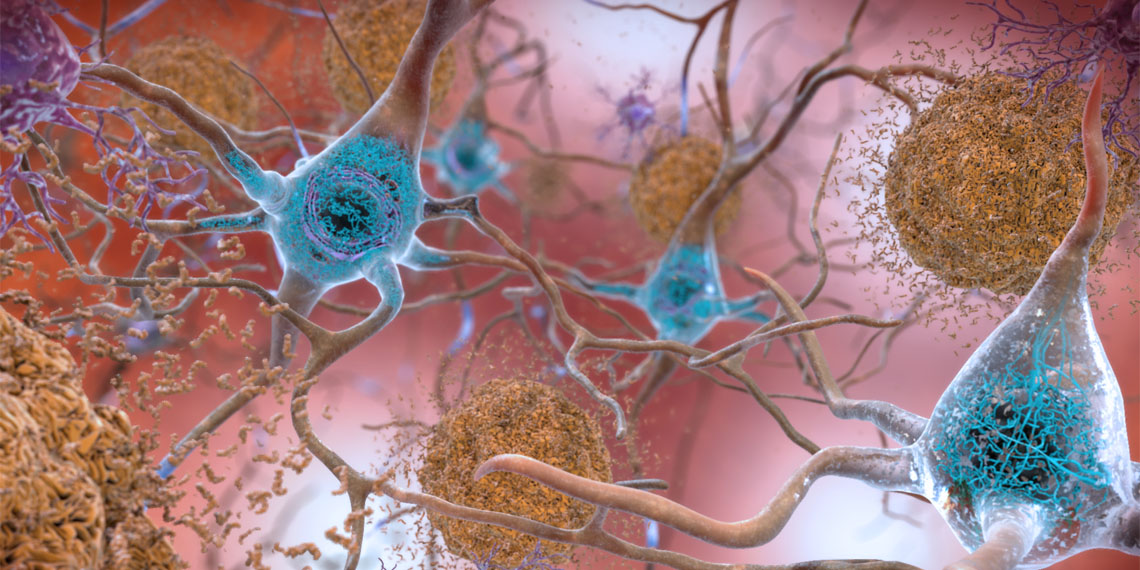
Alzheimer’s disease is one of the primary causes of disability and dependency in the elderly. It affects around 30 million people worldwide. It is thought to be caused by abnormal build-up of proteins in and around brain cells. This build-up leads to problems in cell functioning, including a decrease in chemical messengers (neurotransmitters) involved in sending nerve impulses between nerve cells.
One of the proteins involved in this abnormal build-up is called amyloid. Its deposits form plaques around brain cells. The other protein is called tau. Its deposits form tangles within brain cells. The association between the level of build-up of these proteins in the brain and the severity of Alzheimer’s disease symptoms is not perfect, but once this build-up goes past a certain level, gradual impairing of memory, learning, communication skills and the ability to perform daily activities is certain to follow.
Recent reports — one on diving beaked whales, another on a 40-year-old bottlenose dolphin, and a third one on pinnipeds — all indicated that changes in the brain related to the accumulation of amyloid and tau are also present in these species. Study author Mark Dagleish and his colleagues wanted to verify that cetaceans do indeed develop neural changes similar to Alzheimer’s disease in humans.
“This project started from a conversation in a pub with someone I had not seen in nearly 30 years,” explained Dagleish, the head of Anatomic Pathology at the University of Glasgow. “Frank works on the biochemical aspects of neurodegeneration and was telling me he would like to look at dolphin brains and I, at that time, was the pathologist who undertook the histological examination of the sea mammals stranded in Scottish coastal waters and my area of interest was the brain also. Humans are supposed to be the only species that develop Alzheimer’s disease spontaneously, but some recent work had suggested some species of cetaceans (whales and dolphins) might be susceptible also, so a systematic study was needed to test this theory.”
The researchers examined samples of specific brain regions of several species of oceanic dolphins that were present in the national archives in Scotland. The samples come from dolphins that died after being stranded on shores in Scotland. The Scottish government funds post-mortem examinations of cetaceans, pinnipeds and marine turtles that strand and die in Scottish coastal waters through the Scottish Marine Animal Stranding Scheme (SMASS).
For carcasses that are in a suitable state of preservation, the whole brain is removed along with samples of a wide range of different tissues. These are fixed in a 10% neutral buffered formal saline solution prior to detailed examination. This study used vertical slices of the brain made through several regions.
The researchers chose samples from animals that had indications of old age such as worn or lost teeth, grossly appreciable relative increase in brain white matter compared to grey matter, or life-long photo identification records. They chose samples from a total of 18 animals – 2 Risso’s dolphins, 5 long-finned pilot whales, 5 white-beaked dolphins, 5 harbor porpoises, and 1 bottlenose dolphin.
The researchers initially conducted immunohistochemistry analyses of two areas of the cerebral cortex region of the brain from each of the animals. The selected sections are equivalent to anatomical areas of the human brain where amyloid plaque accumulates initially in Alzheimer’s disease. If evidence of amyloid plaque accumulation was found, sections of all brain regions available from the animal were subjected to further analysis.
Dagleish and his colleagues looked for amyloid plaques, accumulations of specific versions of the tau protein and for signs of gliosis. Gliosis happens when body starts creating more or larger cells that support nerve cells in the brain. These cells are called glial cells. While they are a normal and necessary part of brain anatomy, in gliosis, the increase in their size or number leads to them damaging or pressuring nerve cells, creating symptoms similar to tumors.
Immunohistochemistry analysis revealed accumulations of amyloid plaque in all studied animals. Three animals from three different species showed several types amyloid plaques and accumulations of a certain type of tau proteins (hyperphosphorylated tau) between neurons. One animal showed several types of tau protein accumulations i.e., neuropil threads, phospho-tau accumulation and neuritic plaques, but no amyloid plaques.
“The simultaneous occurrence of amyloid-beta plaques and hyperphosphorylated tau pathology in the brains of odontocetes shows that these three species develop Alzheimer-disease-like neuropathology spontaneously. The significance of this pathology with respect to the health and, ultimately, death of the animals remains to be determined. However, it may contribute to the cause(s) of unexplained live-stranding in some odontocete species and supports the ‘sick-leader’ theory,” the researchers wrote.
The sick-leader theory proposes that healthy dolphins find themselves in dangerously shallow waters after following a confused or lost group leader. This situation than results in stranding. Evidence provided by this study, that dolphins can develop neural conditions similar to Alzheimer’s disease in humans, indicates that this might be a mechanism through which leaders of dolphin pods become cognitively impaired, leading to stranding.
“The species of dolphin affected may help us to identify some of the earliest changes in the pathology associated with Alzheimer’s disease, which could lead to earlier diagnosis and also the targets for potential treatments and also may help identify some of the risk factors associated with developing the disease,” Dagleish told PsyPost.
The paper sheds light on important neural processes in mammals, but it also has limitations that need to be taken into account. Namely, the sample of studied animals was very small and there was no evidence that examined animals, although aged, were indeed pod leaders.
“The main thing to remember is that for a diagnosis of Alzheimer’s disease you need to assess the person/animal for cognitive deficits as, without this, a diagnosis cannot be made, even if the typical pathology is present,” Dagleish noted. “Obviously, this require the person/animal to be alive and amenable to undergoing these tests. We are looking for funding to widen the scope of the study to examine the brains from other species and also more animals to be able to make more accurate conclusions about this work.”
“This was a highly collaborative study across many institutes in Scotland and made possible by the Scottish Government’s long-term funding of the Scottish Marine Animal Stranding Scheme investigating the animals that strand in Scottish coastal waters,” he added.
The study, “Alzheimer’s disease-like neuropathology in three species of oceanic dolphin”, was authored by Marissa C. Vacher, Claire S. Durrant, Jamie Rose, Ailsa J. Hall, Tara L. Spires-Jones, Frank Gunn-Moore, and Mark P. Dagleish.









Discussion about this post