


Brazilian researchers found that boosting the synthesis of hevin, a glycoprotein naturally secreted by astrocytes, led to enhanced neuronal connectivity in rodents.
In Brazil, researchers from the Federal University of Rio de Janeiro (UFRJ), along with collaborators from the University of São Paulo (USP), have discovered a molecule called hevin that can reverse cognitive impairment. The study, conducted in mice, revealed that this glycoprotein, produced by brain cells known as astrocytes, can increase the connections between neurons (synapses) in both aged mice and in animal models of Alzheimer’s disease.
“Hevin is a well-known molecule involved in neural plasticity. It’s naturally secreted by cells in the central nervous system that support the functioning of neurons and are known as astrocytes. We found that the overproduction of hevin is capable of reversing cognitive deficits in aged animals by improving the quality of synapses in these rodents,” says Flávia Alcantara Gomes, head of the Cellular Neurobiology Laboratory the UFRJ Institute of Biomedical Sciences.
The study, published in the journal Aging Cell, was supported by the Ministry of Health, the Carlos Chagas Filho Foundation for Research Support in the State of Rio de Janeiro (FAPERJ), and FAPESP.
It’s important to note that there is still a long way to go before a molecule involved in reversing cognitive impairment can become a drug. This is a basic science study in mice. Another key consideration is whether the compound can cross the blood-brain barrier, which would require efforts to design molecules with this property and the same therapeutic potential.
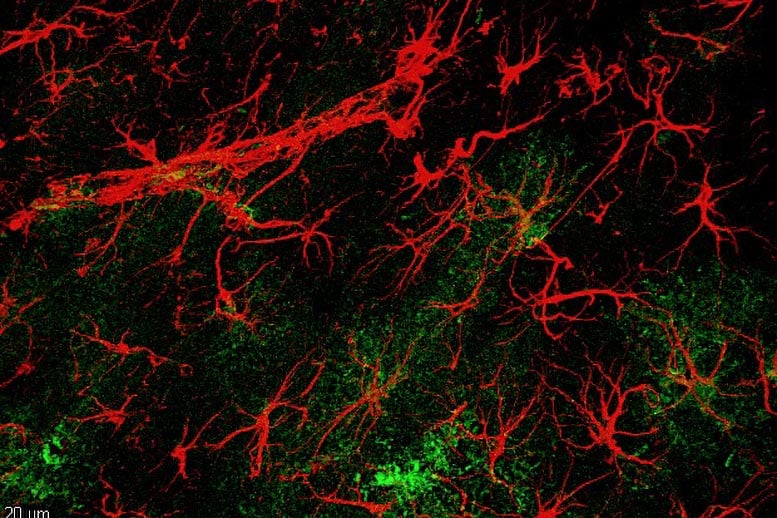
Rodent hippocampal astrocytes (in red) overexpressing hevin (in green). Credit: Felipe Cabral-Miranda and Ana Paula Bergamo Araujo“Of course, in the future it’ll be possible to develop drugs that have the same effect as hevin. For now, however, the fundamental benefit of this work is a deeper understanding of the cellular and molecular mechanisms of Alzheimer’s disease and the aging process. The originality lies in understanding the role of the astrocyte in this process. We’ve taken the focus away from neurons, shedding light on the role of astrocytes, which we’ve shown could also be a target for new treatment strategies for Alzheimer’s disease and cognitive impairment,” says Gomes.
Evidence-based hypothesis
By observing public data, the researchers found that hevin levels in the brain of Alzheimer’s patients decrease compared to healthy individuals of the same age. With this information and using a recombinant viral vector, the group at the UFRJ Institute of Biomedical Sciences overexpressed hevin in astrocytes from aged animals and in transgenic animal models of Alzheimer’s disease.
In addition, the set of proteins produced by the brain cells (brain proteome) of these animals was also analyzed. Comparing the animals with and without hevin overproduction, the researchers found that 89 proteins were differentially expressed. This stage of the work was carried out in the “Redox Proteomics Core” Multiuser Laboratory of the Center for Redox Processes in Biomedicine (Redoxoma) – a FAPESP Research, Innovation and Dissemination Center (RIDC) based at the University of São Paulo’s Institute of Chemistry (IQ-USP).
“The synapse depends on proteins to release a chemical signal from one neuron to another. Proteomic analysis showed that hevin reinforcement in astrocytes regulates different groups of proteins involved in synapses. We observed an increase in synapses, or in other words, a closer connection between neurons and, consequently, better cognitive performance,” explains Danilo Bilches Medinas, professor at the IQ-USP Department of Biochemistry.
Amyloid plaques
In addition to identifying the potential of hevin to reverse cognitive deficits in rodents through behavioral testing, the researchers also observed that overexpression of the molecule in astrocytes did not affect the deposition of beta-amyloid plaques in the hippocampus – a hallmark of Alzheimer’s disease that has been the focus of disease studies and a target for drug development.
“To our surprise, although the cognitive deficit was reversed in Alzheimer’s model animals, there was no change in the content of the plaques. This highlights the complexity of the disease in terms of having a multifactorial mechanism. This is illustrated by older people who have plaque formation but show no symptoms of the disease,” says Felipe Cabral-Miranda, a biomedical scientist at the UFRJ Institute of Biomedical Sciences and first author of the study.
“Although there’s still no consensus among researchers, I work with the hypothesis that the formation of beta-amyloid plaques isn’t the cause of Alzheimer’s. And the results of the study, by providing proof of concept for a molecule that can reverse cognitive decline without affecting beta-amyloid plaques, support the hypothesis that these, although involved in the mechanisms of the pathology, aren’t enough to cause Alzheimer’s,” he adds.
Reference: “Astrocytic Hevin/SPARCL-1 Regulates Cognitive Decline in Pathological and Normal Brain Aging” by Felipe Cabral-Miranda, Ana Paula Bergamo Araujo, Danilo Bilches Medinas and Flávia Carvalho Alcantara Gomes, 12 February 2025, Aging Cell.
DOI: 10.1111/acel.14493
The study was funded by the São Paulo Research Foundation.
Never miss a breakthrough: Join the SciTechDaily newsletter.









Discussion about this post