


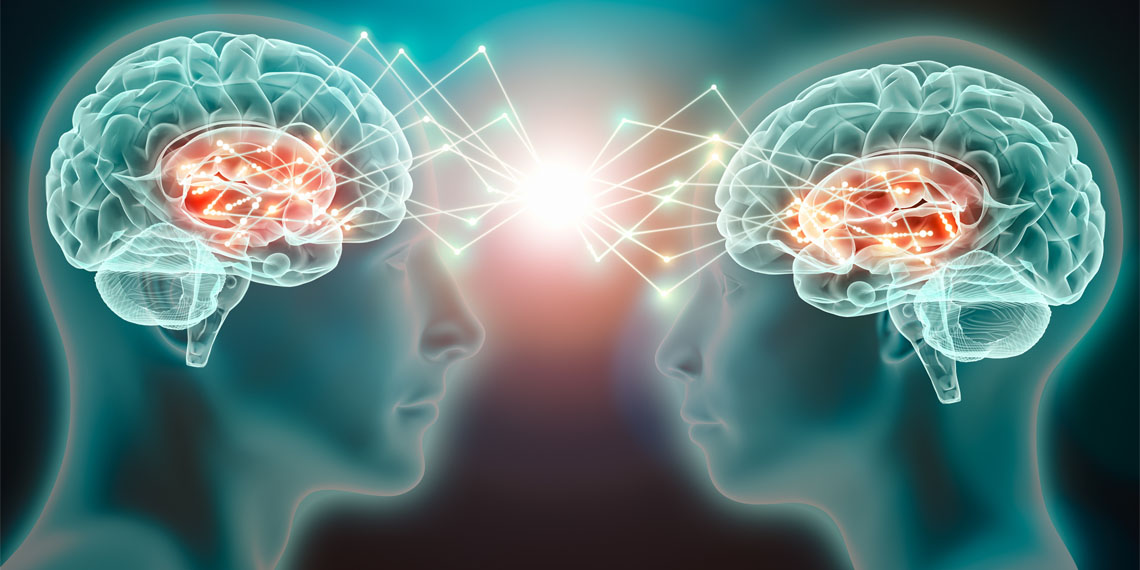
Just by observing the natural behavior of someone we know well, our brain activity can start to sync up with theirs, according to new research published in NeuroImage. The findings shed light on the fascinating interplay between social behavior and brain activity.
Successful social interaction depends on our ability to exchange information with others and continuously update our understanding of their inner states and actions. The authors of the new study sought to better understand the role of a phenomenon called interpersonal neural synchrony (INS) – the alignment of brain activities between people who are interacting.
Previous studies have supported the idea that INS can predict the success of social interactions. However, most research on INS has focused on structured social tasks, trying to establish a relationship between INS and social behavior. What has been less clear is how INS originates or what triggers it.
“Social interaction is a participatory experience, but neuroscience has traditionally looked at it by examining individuals rather than groups,” explained study authors Giacomo Novembre (@NovembreGiacomo) and Atesh Koul (@ateshkoul), the director of the Neuroscience of Perception and Action Lab and a postdoctoral researcher, respectively.
“Interpersonal neural synchrony is a biological measure that captures how multiple brains work together in the context of social interactions. It might be only the tip of the iceberg, and we believe that the future holds much more to discover.”
To study this, the researchers recruited 23 pairs (dyads) of participants who were familiar with each other. They designed an experiment where participants simply looked at each other and behaved spontaneously, without any specific task or instruction to guide their interaction.
Novembre, Koul, and their colleagues set up four different conditions under which the participants interacted: one where they could see each other and were near (1m apart), one where they could see each other and were far (3m apart), one where they couldn’t see each other and were near, and one where they couldn’t see each other and were far. They also had two control conditions: one where participants were doing a social task (holding hands), and one where they were in separate rooms (the baseline).
While participants were in these conditions, researchers used electroencephalography (EEG) to measure their brain activities, and eye-tracking and video-analysis to measure their behavior — specifically their eye contact, body movements, and smiling. These were all tracked and recorded over several two-minute trials.
The researchers found that even without a structured task, INS emerged spontaneously when the participants could see each other. The specific profile of INS activity comprised the envelopes of frontal alpha, right-posterior beta, and occipital-parietal gamma EEG activity. This pattern of activity couldn’t be explained by similar individual neural activities, suggesting that it emerged specifically from the interaction between the dyads.
“We were hoping to observe that two people simply looking at each other exhibit synchronized brain activity,” Novembre and Koul said. “The experiment was designed to test this hypothesis. But it was still surprising to see this.”
The researchers observed that specific behaviors – eye contact, body movement, and smiling – were mirrored between the individuals in a dyad and played a crucial role in predicting and causing the emergence of INS.
The researchers also found that social behaviors and brain synchrony reciprocally influenced each other. Interestingly, social behaviors seemed to have a more substantial impact on brain synchrony than the other way around. This means that when two people interact, their joint behaviors like eye contact or smiling might trigger their brains to ‘sync up’ more than the ‘brain sync’ triggers their behaviors.
The findings indicate “that it’s sufficient to watch the spontaneous behavior of another (familiar) individual, to fall into a state of interpersonal neural synchrony,” Novembre and Koul told PsyPost. “Others’ neural activity is not visible, but is contagious and spread interpersonally through behavioral cues.”
This implies that simply being in the same environment and being able to see each other led to synchrony in both behavior and brain activity, suggesting that INS could be considered a fundamental property of social interaction. The synchrony was a natural occurrence, arising spontaneously rather than being directed by any specific task. In other words, simply having two people share the same social environment can lead to the synchronized variation of both behavior and brain activity.
But it is not clear if the same pattern of findings would be observed with two strangers. “We don’t know if unfamiliar individuals synchronize their brains just by looking at each other, as familiar dyads do,” the researchers said. “This remains an open question.”
“When it comes to the sample of participants, 1 + 1 is not always equal to 2,” Novembre and Koul explained. “When studying a dyad, as opposed to two individuals separately, we observe emergent phenomena that are not observable by looking at individuals alone. In our work, we also show this by comparing intra- and inter-brain neural dynamics.”
The study, “Spontaneous dyadic behavior predicts the emergence of interpersonal neural synchrony”, was authored by Atesh Koul, Davide Ahmar, Gian Domenico Iannetti, and Giacomo Novembre.











Discussion about this post