Thursday, August 20, 2026
Innovatyve Wellness Solutions
  • Home
  • Health
    • Brain Research
  • Obesity and Weight
  • Mental Health
    • Alzheimers Disease
    • Bipolar Disorder
    • Cognition
    • Depression
  • More
    • Mindfulness
    • Neuroscience
    • Relationships
  • Contact
No Result
View All Result
HealthNews
No Result
View All Result
Home Brain Research

Making invisible therapy targets visible

Editorial Team by Editorial Team
July 6, 2023
in Brain Research
0
Making invisible therapy targets visible
0
SHARES
577
VIEWS
Share on FacebookShare on Twitter


A powerful new technology reveals hidden molecular structures in cells and tissues.
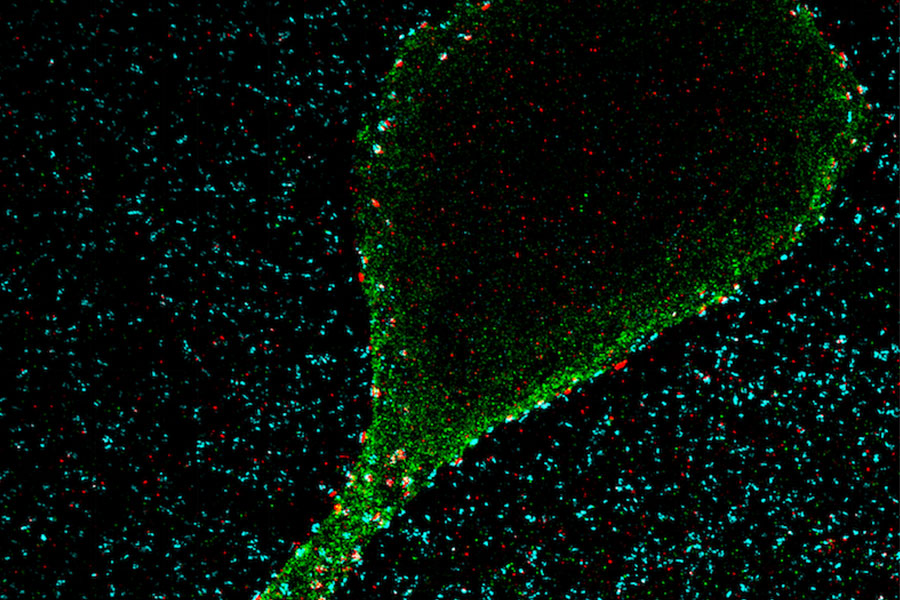
Molecular structures imaged with Expansion Revealing technique. The green signal is a parvalbumin interneuron. Synaptic proteins Btbd11 (red) and Bassoon (cyan) are expressed on the cell membrane. Image: Menglong Zeng and Jinyoung Kang

The lab of Edward Boyden, the Y. Eva Tan Professor in Neurotechnology, has developed a powerful technology called Expansion Revealing (ExR) that makes visible molecular structures that were previously too hidden to be seen with even the most powerful microscopes. It “reveals” the nanoscale alterations in synapses, neural wiring, and other molecular assemblies using ordinary lab microscopes. It does so this way: Inside a cell, proteins and other molecules are often tightly packed together. These dense clusters can be difficult to image because the fluorescent labels used to make them visible can’t wedge themselves between the molecules. ExR “de-crowds” the molecules by expanding the cell using a chemical process, making the molecules accessible to fluorescent tags.

Jinyoung Kang is a J. Douglas Tan Postdoctoral Fellow in the Boyden and Feng labs. Photo: Steph Stevens

“This technology can be used to answer a lot of biological questions about dysfunction in synaptic proteins, which are involved in neurodegenerative diseases,” says Jinyoung Kang, a J. Douglas Tan Postdoctoral Fellow in the labs of Boyden and Guoping Feng, the James W. (1963) and Patricia T. Poitras Professor of Brain and Cognitive Sciences. “Until now, there has been no tool to visualize synapses very well at nanoscale.”

Over the past year, the Boyden team has been using ExR to explore the underlying mechanisms of brain disorders, including autism spectrum disorder (ASD) and Alzheimer’s disease. Since the method can be applied iteratively, Boyden imagines it may one day succeed in creating a 100-fold magnification of molecular structures.

“Using earlier technology, researchers may be missing entire categories of molecular phenomena, both functional and dysfunctional,” says Boyden. “It’s critical to bring these nanostructures into view so that we can identify potential targets for new therapeutics that can restore functional molecular arrangements.”

The team is applying ExR to the study of mutant-animal-model brain slices to expose complex synapse 3D nanoarchitecture and configuration. Among their questions: How do synapses differ when mutations that cause autism and other neurological conditions are present?

Using the new technology, Kang and her collaborator Menglong Zeng characterized the molecular architecture of excitatory synapses on parvalbumin interneurons, cells that drastically influence the downstream effects of neuronal signaling and ultimately change cognitive behaviors. They discovered condensed AMPAR clustering in parvalbumin interneurons is essential for normal brain function. The next step is to explore their role in the function of parvalbumin interneurons, which are vulnerable to stressors and have been implicated in brain disorders including autism and Alzheimer’s disease.

The researchers are now investigating whether ExR can reveal abnormal protein nanostructures in SHANK3 knockout mice and marmosets. Mutations in the SHANK3 gene lead to one of the most severe types of ASD, Phelan-McDermid syndrome, which accounts for about 2 percent of all ASD patients with intellectual disability.



Source link

Tags: invisibleMakingTargetsTherapyVisible
Advertisement Banner
Previous Post

Adolescents tend to be less creative than adults, neuroimaging study finds

Next Post

Cox Exec Talks Impact of Leaving Smart Hospital Technology

Editorial Team

Editorial Team

Next Post
Cox Exec Talks Impact of Leaving Smart Hospital Technology

Cox Exec Talks Impact of Leaving Smart Hospital Technology

Discussion about this post

Recommended

Chronic wasting disease detected in four more Illinois counties – wandtv.com

Stomach bug ripping through Long Island households, classrooms – Newsday

6 months ago
Unpacking auditory hallucinations – MIT McGovern Institute

Unpacking auditory hallucinations – MIT McGovern Institute

3 years ago

Don't Miss

Chronic wasting disease detected in four more Illinois counties – wandtv.com

Ebola started in DR Congo earlier and officials are playing catch-up, WHO warns – BBC

August 10, 2026
Scientists Discover a Hidden Way T Cells Attack Leukemia

Scientists Discover a Hidden Way T Cells Attack Leukemia

August 8, 2026
The Growing Disconnect Between Clinical Documentation and Reimbursement

The Growing Disconnect Between Clinical Documentation and Reimbursement

August 6, 2026
Collagen vs. Creatine vs. Colostrum: Which Is Best?

Collagen vs. Creatine vs. Colostrum: Which Is Best?

August 4, 2026

Recent News

This Common Gut-Bacteria Compound May Be Linked to Alzheimer’s Disease

This Common Gut-Bacteria Compound May Be Linked to Alzheimer’s Disease

August 18, 2026
How Multilingual AI Scribes Are Bridging Communication Gaps at the Point of Care

How Multilingual AI Scribes Are Bridging Communication Gaps at the Point of Care

August 16, 2026

Categories

  • Alzheimers Disease
  • Brain Research
  • Cognition
  • Depression
  • Health
  • Mental Health
  • Mindfulness
  • Neuroscience
  • Relationships

Follow us

Recommended

  • This Common Gut-Bacteria Compound May Be Linked to Alzheimer’s Disease
  • How Multilingual AI Scribes Are Bridging Communication Gaps at the Point of Care
  • 9 Summer Eating Habits You’re Missing to Stay Fueled and Energized
  • Why Your Skin Does Its Best Work While You Sleep
  • Ebola started in DR Congo earlier and officials are playing catch-up, WHO warns – BBC

© 2022 Psychology Aisle

No Result
View All Result
  • Home
  • Health
    • Brain Research
  • Obesity and Weight
  • Mental Health
    • Alzheimers Disease
    • Bipolar Disorder
    • Cognition
    • Depression
  • More
    • Mindfulness
    • Neuroscience
    • Relationships
  • Contact

© 2022 Psychology Aisle