


While keyboards dominate modern classrooms, a new study in Frontiers in Psychology suggests handwriting may be irreplaceable when it comes to learning. Researchers found that writing by hand activates far more extensive and interconnected brain networks compared to typing, particularly in regions linked to memory and sensory processing. These findings provide new evidence that handwriting engages the brain in unique ways, raising concerns about the growing reliance on digital tools for education.
As digital tools replace traditional handwriting in classrooms, concerns have arisen about how this shift might impact learning. Typing on a keyboard is often preferred because it enables children to express themselves more quickly and with less physical strain. However, prior research has shown that handwriting is linked to better memory retention, letter recognition, and overall learning outcomes. The fine motor movements involved in handwriting seem to stimulate the brain differently than typing, but the exact neurological mechanisms behind this difference remained unclear.
To investigate, the researchers focused on brain connectivity, which describes how different brain regions work together to accomplish a task. By comparing brain activity during handwriting and typing, the team hoped to uncover whether the physical act of handwriting promotes more extensive brain communication patterns—patterns thought to support learning and memory formation.
“The brain research on handwriting is really a spin-off of our infant brain research in the NuLab, our developmental neuroscience laboratory at the Norwegian University of Science and Technology (NTNU), where we show that babies are born with a brain that is ready to learn from day one,” said study author Audrey van der Meer, a professor of neuropsychology.
For their new study, the researchers recruited 40 university students in their early twenties. To ensure consistency, only right-handed participants were included in the analysis, as determined by a standardized handedness assessment. After excluding participants whose data contained artifacts, the final sample consisted of 36 individuals.
Each participant completed two tasks: handwriting and typing. For the handwriting condition, participants used a digital pen to write visually presented words in cursive directly on a touchscreen. For the typing condition, participants typed the same words on a keyboard using only their right index finger. Participants wrote or typed each word repeatedly within a 25-second window while brain activity was recorded. To avoid visual distractions, the words did not appear on the screen during typing.
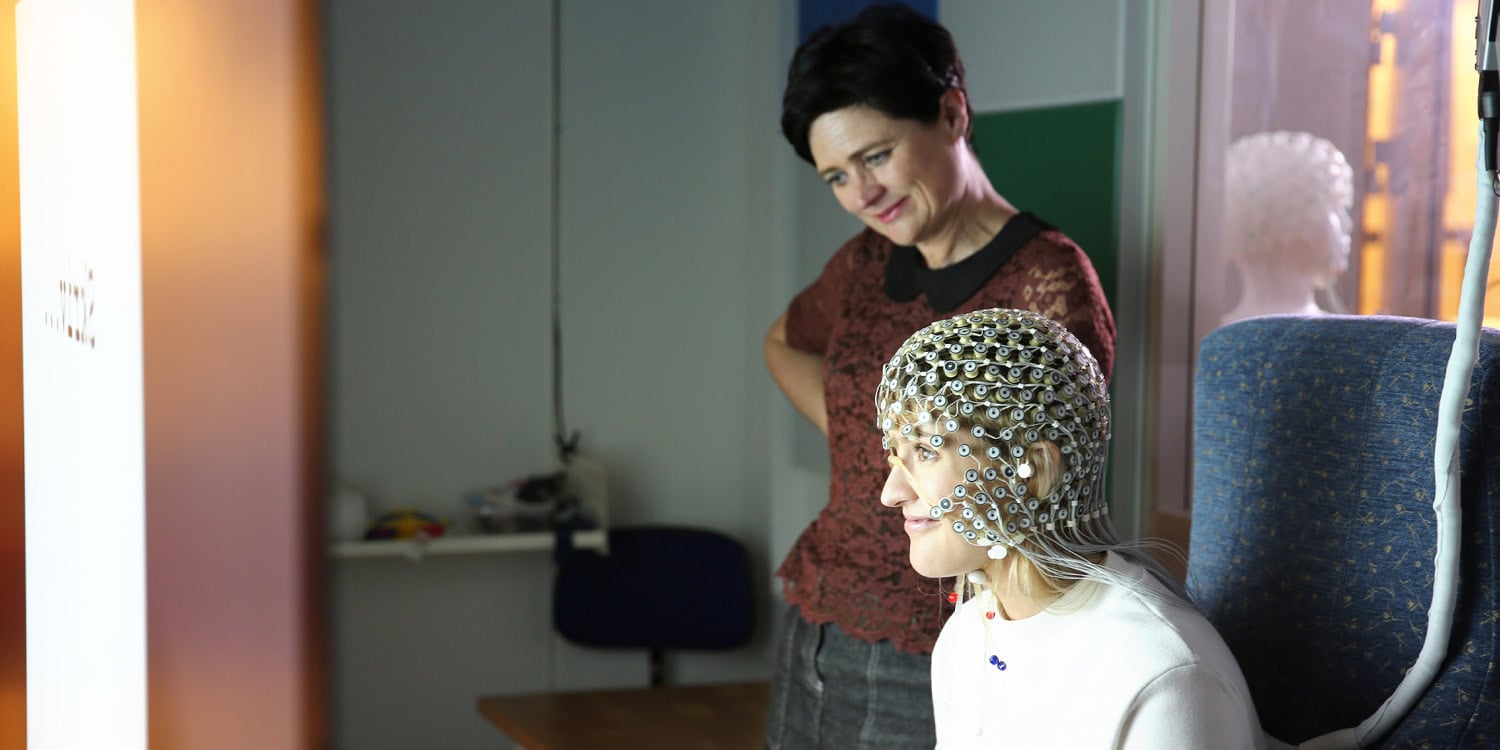
Brain electrical activity was measured using high-density electroencephalography (EEG), a method that captures rapid changes in brain activity using a net of sensors placed on the scalp. The researchers focused on connectivity, analyzing how strongly different brain regions communicated with each other while participants wrote or typed.
“In our previous studies, critics sometimes mentioned we had tested too few participants,” van der Meer told PsyPost. “This time, we recruited 40 young adults and were able to use the brain data from 36. This is a massive amount of data given that our EEG nets consist of 256 electrodes and can record data at up to 1,000 Hz.”
The results revealed striking differences in brain activity between handwriting and typing. Handwriting activated far more widespread and interconnected brain networks than typing, particularly in the theta (3.5–7.5 Hz) and alpha (8–12.5 Hz) frequency bands. These brain waves, particularly in the lower frequency range, are associated with memory formation, sensory processing, and attention.
The most significant connectivity patterns during handwriting emerged in central and parietal brain regions, which are involved in processing motor control, sensory input, and higher-order cognitive tasks. In contrast, typing produced far less synchronized activity across these areas, indicating that pressing keys involves far less integration of visual, motor, and sensory input than forming letters by hand.
The researchers proposed that handwriting’s benefits arise from the spatiotemporal complexity of the task. Handwriting requires precise coordination of vision, motor commands, and sensory feedback as the brain continuously adjusts finger and hand movements to shape each letter. Typing, on the other hand, relies on repetitive keystrokes that provide minimal motor variation or feedback.
“In our handwriting research, it becomes clear that the brain works differently when writing by hand as opposed to when typing on a keyboard,” van der Meer explained. “Precisely forming letters by hand requires fine motor skills and involves the body and senses to a much larger degree than typing on a keyboard does. As a result, handwriting involves most of the brain, requiring the brain to communicate fast and efficiently between its active parts.”
“Our latest results show widespread brain connectivity for handwriting but not for typewriting, suggesting that the spatiotemporal pattern from visual and proprioceptive information obtained through the precisely controlled hand movements when using a pen, contribute extensively to the brain’s connectivity patterns that promote learning.”
The study’s findings suggest that handwriting should remain an essential part of education, especially for young children whose brains are still developing. The researchers argue that handwriting’s ability to engage the brain more fully provides “optimal conditions for learning,” making it an important tool for fostering cognitive growth.
Rather than abandoning handwriting in favor of digital tools, the researchers recommend a balanced approach. While keyboards are useful for certain tasks, handwriting offers unique neurological benefits that cannot be replicated by typing alone. Schools, therefore, should prioritize handwriting instruction to ensure children develop the brain connectivity patterns that support lifelong learning.
“Our brain research shows that handwriting is very good brain stimulation—especially for the developing brain in young children,” van der Meer said. “Therefore, we propose a minimum of handwriting tuition for all children in the lower grades. Also, we see the ability to write by hand and to draw as an important part of our cultural heritage, and we think it is important that the next generation is able to write a poem or love letter by hand. Incidentally, based on our 2020 paper, 20 states in the United States decided to reintroduce handwriting instruction in schools.”
“We are sometimes accused of being against all digital development and wanting to go back to the stone age. All we are saying is that while it is vital to maintain handwriting practice at school, it is also important to keep up with continuously developing technological advances. Therefore, teachers and pupils alike should be aware of which practice has the best learning effect in what context, for example, when taking lecture notes or when writing an essay.”
While the study provides evidence that handwriting promotes more extensive brain connectivity, it does have limitations. The participants were young adults, so the findings may not generalize to children or older adults. Additionally, the study used digital handwriting, which may differ slightly from traditional pen-and-paper writing in terms of sensory input and motor control.
The researchers plan to address these limitations in future studies. For example, they are investigating whether students who take notes by hand learn more effectively than those who type. They also hope to explore whether older adults who practice handwriting regularly exhibit slower cognitive decline than those who rely exclusively on digital tools.
The study, “Handwriting but not typewriting leads to widespread brain connectivity: a high-density EEG study with implications for the classroom,” was authored by F. R. (Ruud) Van der Weel and Audrey L. H. Van der Meer.











Discussion about this post