


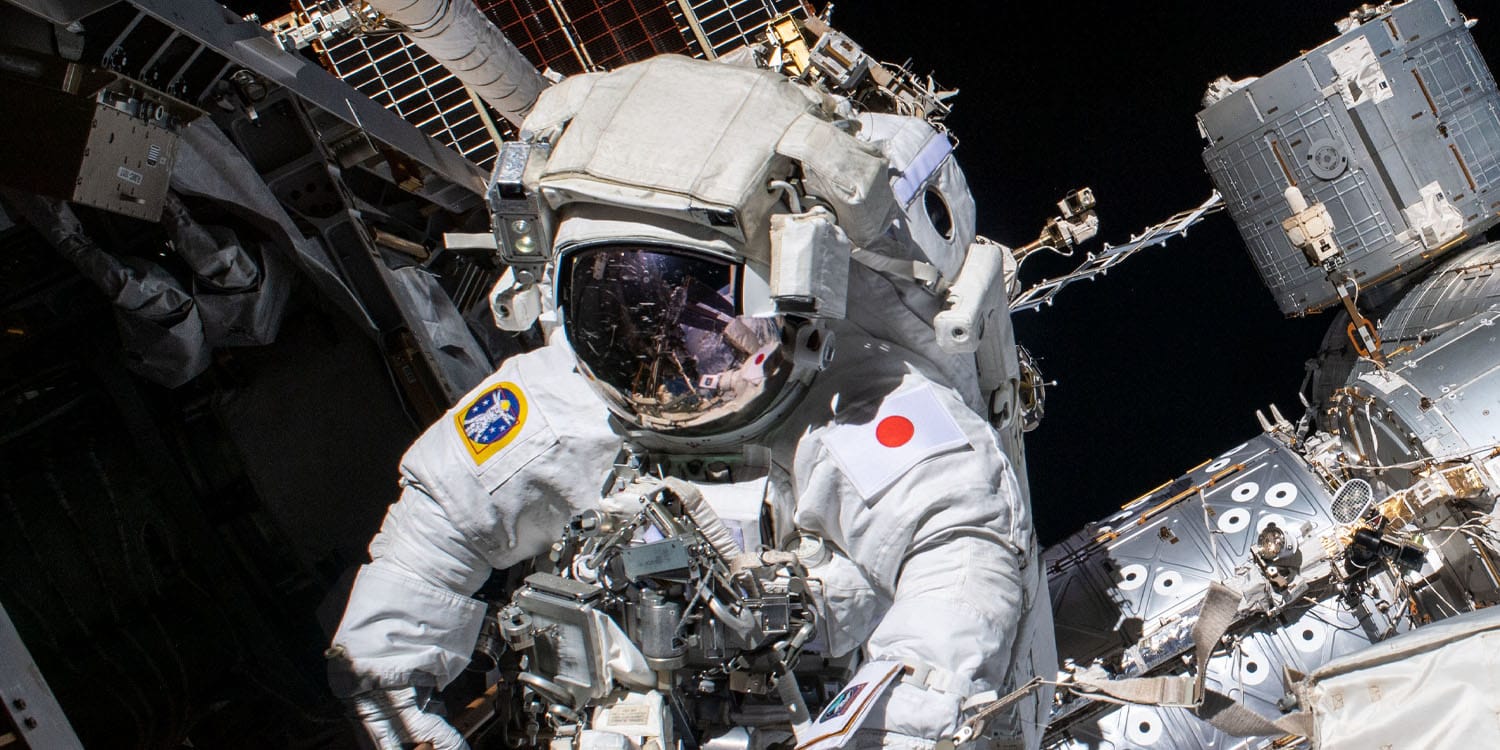
Astronauts possess an uncanny knack for judging distances in the weightlessness of space, according to new research published in the journal npj Microgravity. The findings revealed that astronauts possess a surprisingly accurate ability to estimate distances traveled in a microgravity environment, such as aboard the International Space Station (ISS).
The research was a collaborative effort spearheaded by York University in partnership with the Canadian Space Agency, NASA, and other international space agencies. But why embark on such a study? The venture into space poses unique challenges to astronauts, among them the absence of gravity.
This lack of gravity affects various bodily functions and senses, including how we perceive movement and orient ourselves in space. Given the critical nature of precise movement and navigation in spacecraft or while conducting spacewalks, understanding and improving astronauts’ spatial awareness in microgravity is paramount.
“It has been repeatedly shown that the perception of gravity influences perceptual skill. The most profound way of looking at the influence of gravity is to take it away, which is why we took our research into space,” said study author Laurence Harris, a psychology professor and director of the Multisensory Integration Lab.
“We’ve had a steady presence for close to a quarter century in space and with space efforts only increasing as we plan to go back to the moon and beyond, answering health-and-safety questions only becomes more important. Based on our findings it seems as though humans are surprisingly able to compensate adequately for the lack of an Earth-normal environment using vision.”
The research focused on two main groups: astronauts who would perform the tasks both on Earth and in the microgravity environment of the ISS, and a control group that underwent similar testing solely on Earth. The astronaut group comprised 15 individuals (8 women and 7 men), though not all completed the study due to various reasons such as delays in their space flight or the inability to complete the second test session within a specific timeframe.
This left 12 astronauts (6 men and 6 women) who fully completed all aspects of the testing protocol. The control group consisted of 22 participants initially, with 20 completing the study due to dropout caused by motion sickness in some cases.
The researchers used virtual reality (VR) technology to simulate a three-dimensional hallway, which served as the primary setting for the experiments. The hallway was designed with light spots on the walls to create optic flow, mimicking the visual cues one would experience while moving through space.
The experimental procedure was carefully crafted to assess the participants’ ability to estimate distances in a simulated environment. Participants viewed a target at various distances in the virtual hallway and were asked to estimate the egocentric distance to the target. Once they had made their estimation, they signaled the start of the trial, and the target disappeared, replaced by optic flow simulating movement towards the target’s location.
Participants then indicated when they felt they had reached the target’s position. This process was repeated across multiple trials and distances, without providing any feedback on performance to ensure that learning effects did not influence the results.
The astronauts underwent testing at five different stages: before their spaceflight, early and late during their mission on the ISS, and early and late after their return to Earth. While on Earth, tests were conducted with astronauts in sitting and supine (lying face up) postures to simulate different orientations relative to gravity.
A key discovery of the research was the significant role that visual cues, or optic flow, play in astronauts’ perception of movement and distance in space. Optic flow refers to the pattern of apparent motion of objects, surfaces, and edges in a visual scene caused by the relative motion between an observer and the scene. In the weightlessness of space, where the vestibular cues related to gravity are not available, astronauts seem to rely more heavily on these visual cues to gauge how far they have traveled.
The study also found that posture affects perception of distance on Earth. Specifically, when participants were in a supine position (lying face up), they tended to estimate distances as being shorter compared to when they were sitting upright. This finding was consistent with the hypothesis that the absence of typical gravitational cues might lead to a greater reliance on visual information for estimating distances.
Furthermore, the results showed no significant difference in the astronauts’ performance before and after their spaceflight. This indicates that the experience of microgravity does not adversely affect the astronauts’ ability to perceive distances upon returning to Earth. It’s an encouraging sign for long-duration space missions, suggesting that astronauts can quickly re-adjust to Earth’s gravity without lasting impairments in spatial perception.
However, the study has its limitations, including the small sample size and the exclusion of data from participants who did not complete all test sessions. Furthermore, the astronauts were not tested immediately upon reaching the ISS, which means the initial adaptation phase to microgravity was not captured.
The researchers call for further studies to explore these findings, especially to understand the long-term effects of spaceflight on spatial orientation and how these insights could benefit people with balance disorders on Earth.
The study, “The effects of long-term exposure to microgravity and body orientation relative to gravity on perceived traveled distance,” was authored by Björn Jörges, Nils Bury, Meaghan McManus, Ambika Bansal, Robert S. Allison, Michael Jenkin, and Laurence R. Harris.









Discussion about this post